"The
two will line up at one end of the plaza and at the count of
three, take off running as fast as they can. The racer kachina
usually takes the lead early on, as they are the fastest. However,
part of the blessing of the kachinas is to let others win, whether
it is a koshare or a young child.
By
the middle of the race, the koshare begins to gain speed. Really,
it is the kachina slowing down so the koshare can catch up. Everyone
gets a good laugh watching the heftier koshares run. In the end,
it always appears to be a close race and we cheer them both on,
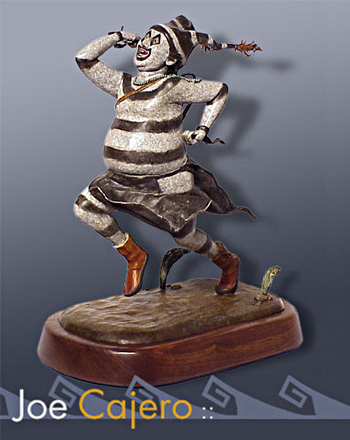
even though we know who is going to win. This is where the inspiration
for this piece came. I wanted to capture the extreme physical
movement of a big-bellied koshare in his efforts to win; his
head tilted up to the left and his tongue poking out of the corner
of his mouth in exertion.
This
koshare has just lifted off from the starting point. His feet
have the slight inward turn of when a runner first sets in motion.
Notice that his right arm and right leg are in sync. This is
opposite of how we really run. When the koshares say or do things,
it is a part of their ritual to always do things backwards or
opposite of what they mean. I wanted to emphasize this aspect
of their society. Also, you can see that by the direction his
breechcloth and turquoise beads are flying, his strong side is
his left. For balance, I gave him a small prayer bag on his right.
The same goes for the vegetation; the smaller shrub is on his
stronger side, while the larger is on his weaker. I like the
effect this gives, with all things being complementary."
(Joe
Cajero)